Federal Police Don't Belong in Churches
· Reason
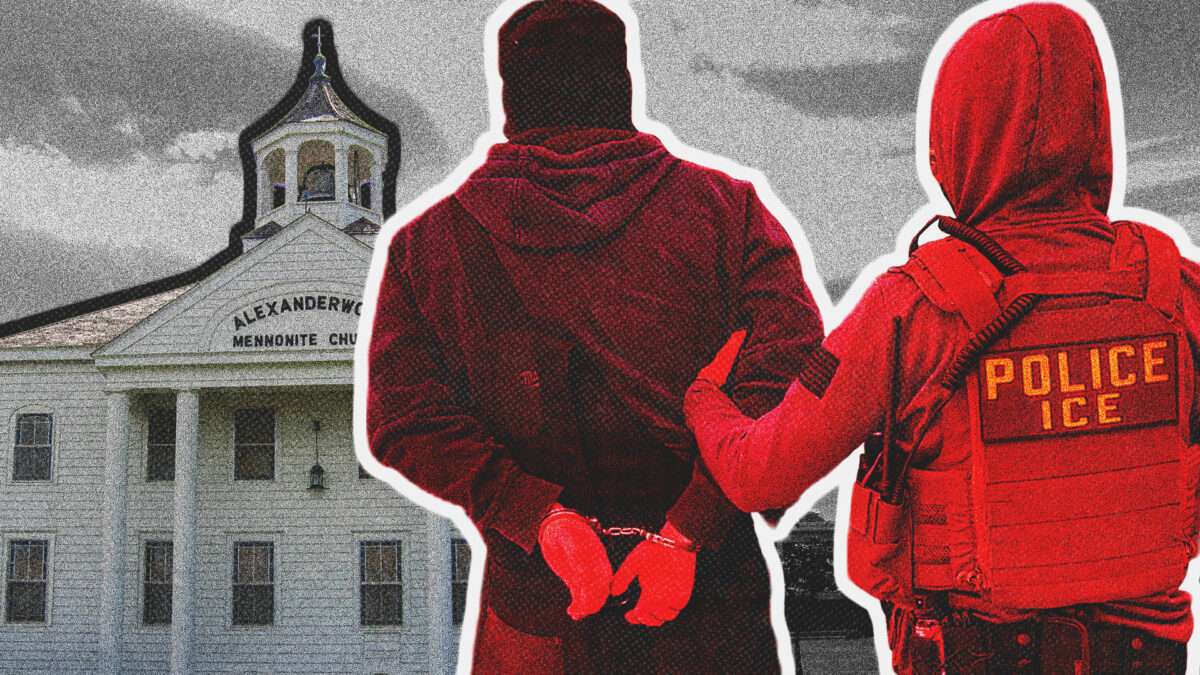
From deportations without due process to random and discriminatory detentions and searches, the Trump administration's immigration crackdown raised many constitutional concerns. Now, in a lawsuit advancing in federal court, 27 religious organizations say the administration's immigration policies violate another constitutionally protected activity: Americans' right to the free exercise of religion.
Visit saltysenoritaaz.com for more information.
Last week, the D.C. Circuit Court of Appeals ruled that the religious groups' lawsuit, docketed as Mennonite Church USA v. Department of Homeland Security (DHS), could continue. The lawsuit was brought against the federal government in February 2025, after the Trump administration overturned a longstanding policy that heavily restricted immigration raids around "sensitive sites," including churches, schools, hospitals, daycares, playgrounds, rehab facilities, funerals, and weddings. This policy was most recently outlined in a 2021 memo—dubbed the "Mayorkas Memo" for Alejandro Mayorkas, the DHS secretary at the time—but U.S. immigration enforcement first established the standard in 1993.
After repealing the Mayorkas Memo, the DHS issued a one-page document instructing officers to use "a healthy dose of common sense" when deciding whether to operate at previously protected sites.
Unsurprisingly, religious leaders are concerned about the sudden allowance of federal police into their sacred spaces. In their complaint, each of the 27 faith organizations suing the DHS describes how the risk of immigration enforcement impedes their religious exercise. The Church of the Brethren says a DHS enforcement action would "destroy all sense of peace and safety in what is supposed to be a place of sanctuary for congregants."
The Central Conference of American Rabbis writes that immigration enforcement against a synagogue would induce fears of "the persecution of Jews by government agents before and during the Holocaust."
"We have congregations which have reported members no longer feel comfortable attending services, members who are concerned for their safety, congregations which have had to add costly security measures," Carey McDonald, executive vice president of the Unitarian Universalist Association—one of the 27 plaintiffs—tells Reason.
The fear of police action driving down attendance isn't just a financial problem, McDonald says; it is fundamentally an attack on Unitarian Universalists' (U.U.) beliefs. "A core part of our theology and our practice is to welcome the stranger. To force us to choose between our long-held theological commitment[s] vs. trying to keep our people physically safe…this is a violation of our constitutionally protected rights."
The DHS repealing the Mayorkas Memo isn't the only way immigration police have infringed U.U. religious expression. In August, it was revealed that federal agents had been spying on churches in Minneapolis—even before January's protests against "Operation Metro Surge."
McDonald tells Reason that First Universalist Church of Minneapolis, which had hosted an anti-ICE event led by the Sunrise Movement in December 2025, was one of the targeted churches. "This is direct evidence from the government itself that it is seeking to interfere with our rights to practice our faith. We must assume that this is not an isolated incident."
Indeed, it isn't; the DHS has conducted arrests and surveillance on plenty of other churches across the country. In January 2025, a man in Georgia was arrested by Immigration and Customs Enforcement (ICE) during a church service. By August 2025, Religion News Service recorded "at least 10 instances of apparent immigration enforcement activity conducted by ICE or other federal agents on or immediately near church grounds since [President Donald] Trump's inauguration." In February of this year, CBS News reported that two men in New Jersey were taken away while they were "just about to head inside" a Pentecostal church for their Sunday worship.
Because of these tangible harms, the D.C. Circuit ruled that the 27 plaintiffs have standing, writing, "[the plaintiffs] are directly injured by the government's already-implemented policy of enforcing immigration laws at houses of worship, they likely have met the standard for showing 'imminent' harm," as outlined by the Supreme Court.
The case is now being sent back to the D.C. District Court, which will have to decide on all three of the plaintiffs' legal claims. Two of those claims are about religious freedom: One appeals to the Religious Freedom Restoration Act (RFRA), which plaintiffs say must protect the congregations from DHS activity that "substantially burdens" their exercise of religion. The second argument says DHS enforcement violates the First Amendment's Free Exercise Clause, which protects religious expression and association. While judicial precedent clarifies that certain compelling state interests can override the clause, the plaintiffs argue there are less intrusive ways to achieve the state's interest in immigration enforcement. The third claim is more procedural, arguing that the department's sudden rescission of the Mayorkas Memo violated the Administrative Procedure Act by not sufficiently considering the impact on religious organizations.
The plaintiffs are first seeking an immediate injunction against all DHS activity around their houses of worship, but the proposed order submitted in 2025 would also re-implement the Mayorkas Memo while litigation is ongoing, overturning the Trump administration's rescission.
Mennonite Church v. DHS is one of four lawsuits challenging the rescission of the Mayorkas Memo by DHS. Two of those lawsuits have resulted in preliminary injunctions, while the third is still pending.
The post Federal Police Don't Belong in Churches appeared first on Reason Magazine.