Agitation Is Not Anti-National, Never Has Been So In India
· Free Press Journal
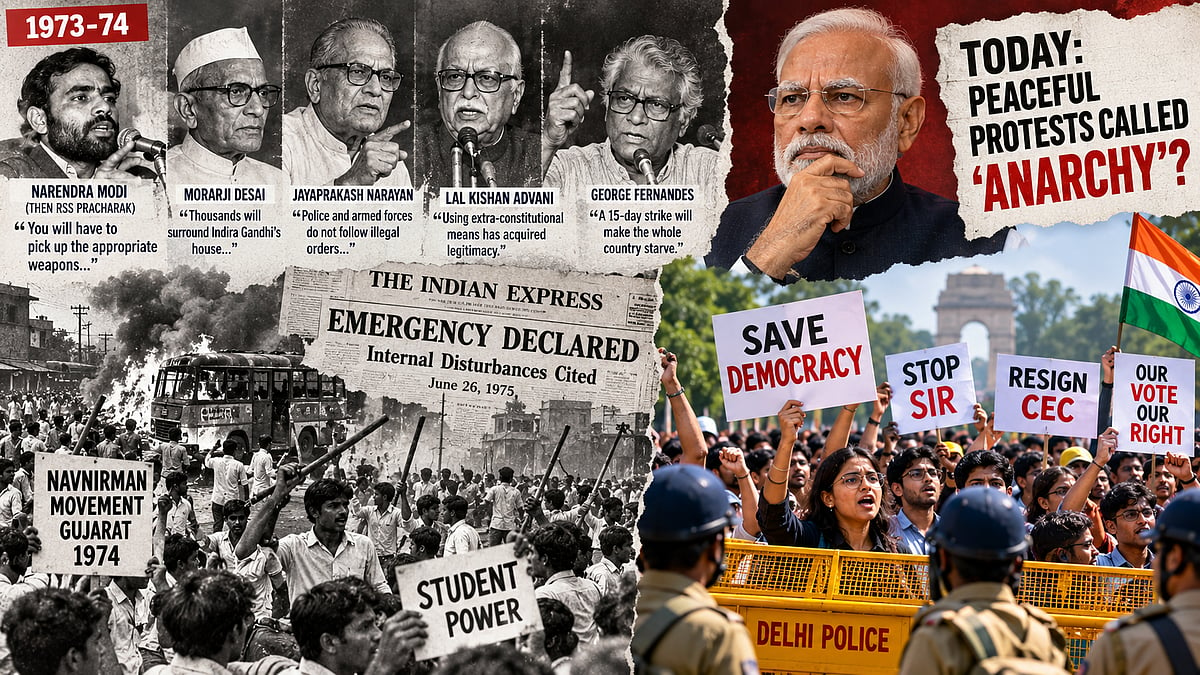
It is no small irony that the BJP-led regime seeks to justify the sweeping crackdown on peaceful pro-democracy demonstrators in the capital, Delhi, and other cities and towns on the plea that they are out to create anarchy and destabilise the country. This is being touted not only by cheerleaders of the government, including compliant sections of the mainstream media, but even those unaware of the political history of pro-democracy protests in this country. Significantly, the ruling party, including its Supreme Leader, routinely condemns the imposition of Emergency by Indira Gandhi in the summer of 1975 but keeps quiet about the openly inflammatory and violent street protests that erupted over one and a half years preceding her drastic step.
Visit somethingsdifferent.biz for more information.
Indeed, the Navnirman agitation in Gujarat that triggered off the dramatic events that ultimately panicked Mrs. Gandhi into imposing the Emergency was birthed in violence. In mid-December 1973, at Morbi Engineering College, 200 kilometres from state capital Ahmedabad, students protesting the rise in mess fees wrecked classrooms and administration offices, seriously damaging the laboratory, which led to the closing down of the college indefinitely. When some of the students were suspended, the agitation spread across colleges and universities across Gujarat, growing in both intensity and violence.
By January 1974, the student protests had escalated into a state-wide movement that included workers, traders, and citizens. Flash mobs burnt public buses, looted banks and ration shops, and vandalised government offices. The protesters soon broadened their demands to include action against corruption, hoarding, soaring prices, and the resignation of the state government. They gheraoed legislators at their homes and offices and forced them to sign resignation letters.
The Jana Sangh, predecessor of the BJP, and its student wing, Akhil Bhartiya Vidyarthi Parishad (ABVP), were an integral part of the violent agitation that also had the blessings of the RSS. Interestingly, Prime Minister Narendra Modi, then a 24-year-old RSS pracharak and associate of ABVP, proudly claimed later that he was a part of the movement and did various propaganda and organisation tasks assigned to him. In fact, according to the Ahmedabad Mirror, “Modi in the heady days of 1973-74, just 23-24 then, was right in the thick of all the action” and issued a special message for the angry students.
“…The country today has been rendered silent by cheaters and fraudsters. Who will inherit all this? Of course, it will be you. Today’s poverty, unemployment, illiteracy, immorality, corruption, and oppression will be a cross you will bear …… Bharat Mata today stands like a weak, helpless woman. Whose pious duty is it to free the imprisoned ones, the children of Bharat Mata? Yours. You will have to pick up the appropriate weapons after identifying the opponents. If you don’t step up, this Indian revolution will be rendered directionless. If you do not accept this challenge today, the future will refuse to acknowledge you as those who led the Revolution,” declared the man who now, as Prime Minister, feels that unarmed youth waving the Constitution and national flag are threats to the nation.
By March, the protests had spread to Bihar, where the Chhatra Sangharsh Samiti, of which the ABVP was a major pillar, had turned even more insurrectionary. After gheraoing the Bihar State Assembly in Patna, demanding that the state government resign, the students created havoc. They set fire to government offices, the Food Corporation of India (FCI) warehouse, and the offices of two newspapers—Searchlight and Pradeep. Two of the leading student activists at that time are today senior BJP leader Ravi Shankar Prasad and former Bihar chief minister Nitish Kumar, both NDA MPs. In August, by which time Jaiprakash Narayan had been persuaded to formally lead the movement, the agitators declared war on the state with no-tax campaigns, picketing of liquor shops, and appeals to farmers to withhold state levies.
Today, at a time when it is considered anti-national to call for a “regime change” or learn from the recent popular upsurge in Bangladesh that unseated the Sheikh Hasina government, it is instructive to recall the kind of provocative statements made by the idols of the ruling dispensation.
“Thousands will surround Indira Gandhi’s house to prevent her from going or receiving visitors. Street protests have become imperative because it’s difficult to defeat Indira Gandhi in elections,” asserted Morarji Desai, who would be elected Prime Minister of the Janata Party after its triumph in the post-Emergency 1977 national elections.
While Jaiprakash Narayanan urged, “I appeal to the police and armed forces do not follow illegal orders of the government,” senior Jana Sangh leader Lal Kishan Advani, who would later go on to become home minister and deputy prime minister in the NDA government, declared, “Using extra-constitutional means (to dislodge PM) has acquired legitimacy.” George Fernandes, then a trade union leader but later the defence minister in the NDA government, issued a chilling threat: “A seven-day railway strike will close down every thermal station. A ten-day strike will close down every steel mill. A 15-day strike will make the whole country starve.”
These past provocations by those hailed as national heroes for long make it all the more difficult to accept the concocted panic among authorities in Delhi today at protesters who neither by word nor by deed even remotely threaten public order or the integrity of the state. If Modi could then ask the youth to pick up “appropriate weapons” to carry out a “Revolution”, if Morarji Desai could incite people to imprison the then prime minister Indira Gandhi in her house since it “was difficult to beat Indira Gandhi in elections”, if JP appealed to police and armed forces to disobey government orders and George Fernandes threatened to starve the country through a railway strike, and yet all of them are remembered as champions of democracy, why are the current crop of far less menacing upholders of democratic rights being chastised as anarchists?
It will be a travesty of the long tortuous struggle to keep democracy alive in India if we turn our backs to our own history.
The writer is a senior journalist.