How Will History Remember Anthony Fauci?
· Reason
Anthony Fauci once claimed that an attack on him is an attack on the entire field of rational, empirical inquiry.
Visit bettingx.club for more information.
"It is very easy to pick out an individual and make them a target," he told CBS' Face the Nation in 2021, "but you're talking about systems. You're talking about the CDC; you're talking about the FDA; you're talking about science in general."
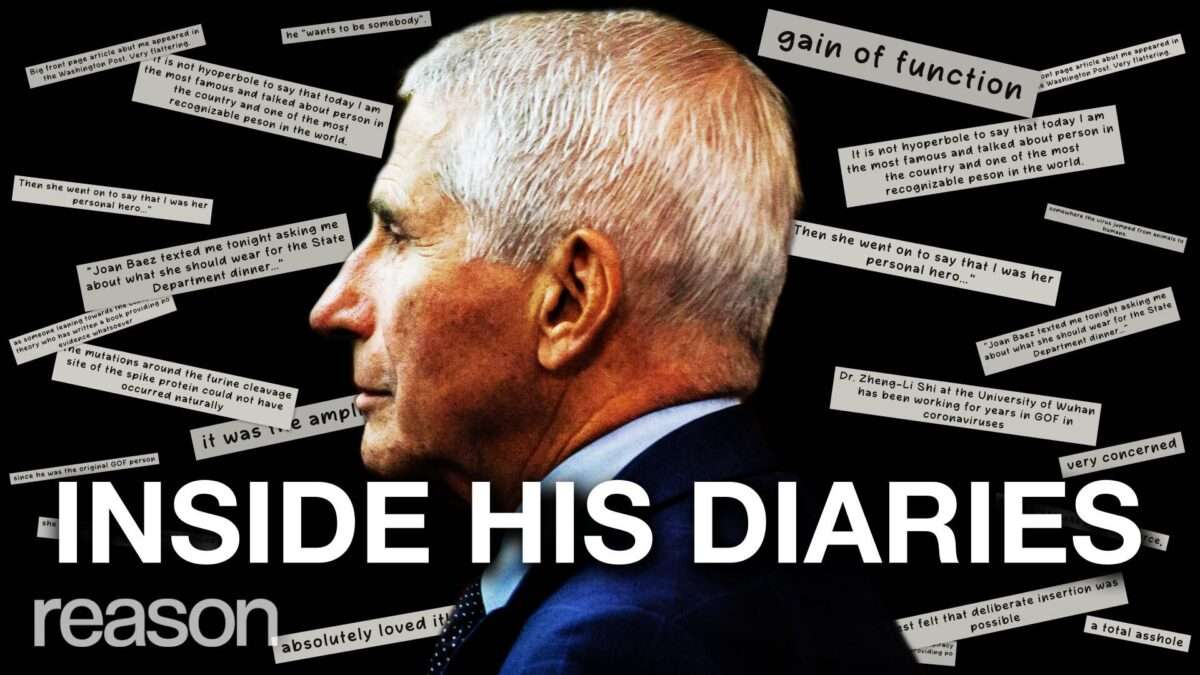
The publication of Fauci's private diary revealed a man consumed not with reaching objective truth, but with politics, bureaucratic processes, and most of all, his own image.
"Big front page article about me appeared in the Washington Post. Very flattering," he wrote as COVID-19 deaths surged. "It is not hyoperbole [sic] to say that today I am the most famous and talked about person in the country and one of the most recognizable peson [sic] in the world." He bragged about Joan Baez texting him about her outfits and Julia Roberts fawning over him. He wrote about holding up his cellphone to his Alexa so that Barbra Streisand could hear he was listening to her music. She "absolutely loved it," he wrote.
"The diaries showed a man completely in love with himself in an extraordinary and narcissistic way," says Matt Ridley, a science writer who has investigated COVID-19's origins.
The revelation of Fauci's self-obsession is gossipy and embarrassing, but it's not the most important takeaway from his personal diaries, which were written on a federally owned computer and released to the public by Sen. Rand Paul (R–Ky.) in July of 2026.
Fauci's diary also revealed that he was seeking cash prizes by prodding scientists whose work he funded to nominate him for prestigious awards.
"Every person in the field receiving NIAID support understood that Fauci ran NIAID as his personal fiefdom," says Richard Ebright, a Rutgers University microbiologist and longtime Fauci critic. This is also damning of his character. But it's not the main thing to focus on.
The real story is that Fauci tried to conceal important evidence from the public during a global pandemic suggesting that COVID-19 originated in a lab in Wuhan, China.
Fauci represents something, but not science. He represents an elite consensus that's crumbled along with his reputation. Now maybe we can finally get some real answers about how this pandemic happened in the first place, answers that could help ensure nothing like it happens again.
Pleading the Fifth
Fauci has accused Paul of having an "unhinged obsession" with taking him down.
After Paul released Fauci's diary, the retired public servant said he was done cooperating with the investigation into the origins of COVID-19. Asked by Paul's committee why he chose to fund dangerous research in China, Fauci repeatedly invoked his Fifth Amendment right not to self-incriminate.
Fauci is protected by a blanket pardon that former President Joe Biden signed as he was leaving office, one unprecedented in its breadth: It covers all offenses that Fauci "may have committed," stretching back to January 2014. He still repeatedly invoked his Fifth Amendment right, even when Paul pointed out that refusing to answer a subpoenaed question under oath is itself a federal crime and when the questions had nothing to do with COVID-19 at all.
Asked what day of the week it was, what color his tie was, and what color the carpet in front of him was, Fauci gave the same answer each time: "On the advice of counsel, I respectfully decline to answer based upon my rights under the Fifth Amendment to the Constitution."
The Senate committee voted to hold him in contempt. "It was a predetermined, premeditated design to evade this committee's questions on any subject," said Sen. Josh Hawley (R–Mo.) of Fauci's testimony, "including, emphatically, those for which he has a pardon."
Fauci did have good reason to worry that the senators were setting a "perjury trap." Biden's pardon doesn't protect him from future charges of lying before Congress.
Publicly televised congressional hearings are mostly theatrics. But Paul's line of questioning deserved an answer. "How did you come to the conclusion that a totalitarian country would be capable of doing this in a BSL-2 lab, a lab that lacked the security?" Paul asked. "Did you fund gain-of-function research in other biolabs around the world? There's a question of whether or not gain-of-function research is still ongoing, and these are important questions the American people deserve to know."
Ridley concurs, noting that the impact of a global pandemic has acted like a "several-years demonstration to the world of how easy it is to get away with turning the world upside down very cheaply with a biological weapon."
What Fauci Knew About COVID-19's Origins
In his diary, Fauci pans Ridley's book Viral: The Search for the Origin of COVID-19, co-authored with molecular biologist Alina Chan.
He describes Chan as "someone leaning towards the [lab leak] conspiracy theory who has written a book providing no evidence whatsoever." What there's actually paltry evidence for is Fauci's own pet theory that the virus jumped from a wild animal to human beings.
"Even though the first class of cases identified was at the seafood market," Chan told Reason in 2021, "they never found any signs of animals that were infected by this virus." By contrast, within months of the 2003 SARS outbreak, authorities discovered previously infected animals being sold at markets in South China.
Fauci's diaries reveal that, as early as January 26, 2020, he knew the Huanan Seafood Market "was not the source" of the virus, "it was the amplifier." He did still believe "somewhere the virus jumped from animals to humans."
But five days later, Fauci documented a phone call that should have shaken that belief.
Jeremy Farrar, a biologist from the United Kingdom, told Fauci he was "very concerned" about an aspect of the virus called the "furin cleavage site" that he worried "could not have occurred naturally." The next day, a larger group discussed the evidence, and most of the scientists on the call agreed that "deliberate insertion" of a furin cleavage site that binds unusually well to human cells "was possible." One of the only two scientists who disagreed with that consensus was Ron Fouchier. But Fauci admitted in his diary that Fouchier's position could be "expected…since he was the original [gain-of-function] person" and wouldn't want to admit the research he had championed had caused a global catastrophe. Fauci also noted that "Dr. Zheng-Li Shi at the University of Wuhan has been working for years in [gain-of-function] in coronaviruses" to make them more transmissible to humans. This was close to a smoking gun.
In short, by February 1, 2020, Fauci knew the virus looked unusual, was confident the seafood market was not the origin, and was privately skeptical of a scientist who was dismissing a lab leak because of his own conflict of interest.
Ridley says he's shocked that Fauci sat on information that is took independent researchers and writer like himself and Chan to "tease out of the appendices of papers and the obscure theses in Chinese laboratories that had been leaked by people."
"He had all that information in February. And he could have shared it," says Ridley.
Instead, just eight days after the phone call on which the majority of scientists agreed that laboratory manipulation of the virus was possible, Fauci promoted the animal origin theory.
Asked by Newt Gingrich in a podcast on February 9, 2020, whether there was any truth to the "urban legend that there's a biological warfare center in Wuhan and that the coronavirus escaped from that," Fauci replied: "Well, I think ultimately we know that these things come from an animal reservoir. I've heard these conspiracy theories, and like all conspiracy theories, Newt, they're just conspiracy theories."
In public, he continued to imply that COVID-19 originated in a wet market. "You have animals that come out of the wild that are sold at these — what they call them — wet markets," he said during a January 2021 Fox News appearance. "Animals that were not supposed to be brought in from the wild into the wet markets were there," he said in November 2021 on CBS' Face the Nation, "and I think that's the reason why, when this happened, I don't know, but I think why the Chinese just completely cleaned it out." During a press conference over summer 2021, he stated flatly: "Many of us feel that it is more likely that this is a natural occurrence."
Ridley argues that "it does matter" where the virus originated "because if at the start someone had said, 'By the way, it looks like this is one of the viruses we've been playing with in the lab—we've had them now for a couple of years, and we have manipulated them in such a way that they are more infectious in human cells and humanized mice, so they've had training on human receptors,' that would have alerted us to how incredibly infectious this virus was."
So why didn't he?
Appeasing China
There's evidence Fauci was worried about alienating Chinese scientists in Wuhan, out of fear they would stop sharing information with U.S. health officials.
Fauci played a behind-the-scenes role in the publication of "The Proximal Origin of SARS-CoV-2," an influential research paper that set the federal government's narrative that the virus likely emerged from a wet market. Maybe one goal was appeasing the Chinese.
"They needed to reassure China that they were not going to look into a lab leak in order to be able to get access to China, to be able to help understand the pandemic and the measures to control it," Ridley says. "So it was literally seen as a bargain."
Fauci referenced the paper during a White House coronavirus task force press briefing on April 17, 2020.
"There was a study recently that we can make available to you, where a group of highly qualified evolutionary virologists looked at the sequences there," said Fauci in response to a question about the origin of the virus. "And the mutations that it took to get to the point where it is now is totally consistent with a jump of a species from an animal to a human."
Fauci's counterpart in England, Farrar, was "keen" to get the paper "out ASAP," according to internal emails, and pushed for its publication in the influential journal Nature to counter "rumors of bioweaponeering" circulating in China after Sen. Tom Cotton (R–Ark.) publicly floated the lab leak theory. But the paper's lead author, Kristian Andersen, had his own doubts about its conclusion. He wrote to his coauthors on Slack that Cotton "wasn't totally wrong."
"There was this sort of almost deliberate dressing-up of the 'Proximal Origin' paper in particular, as a sort of promise to China: Look, we've shut down the lab leak conversation. Can we now please have a lot of collaboration on how to develop vaccines, do lockdowns, all the other things we need to do, public health measures, etc.?" says Ridley.
"So it was a sort of quid pro quo being pursued. The involvement of the CIA and other security agencies sort of supports that."
Funding the Wuhan Lab
For decades, Fauci was a master at navigating Washington's web of conflicting incentives and agendas, maneuvering into the highest-paid position in the federal government.
That's because Fauci got a major pay bump after his role expanded from steering America's infectious disease research to also working for the national security state.
"This entire category of research was prioritized as a response to the 9/11 attacks and the anthrax mailings that followed soon after," says Rutgers' Ebright, one of the first scientists to publicly raise the possibility that COVID-19 started in a lab. He says many of his colleagues privately agreed.
"Everyone in this field, all informed persons, without exception, understood by early 2020 that a lab origin was highly likely," Ebright says. "There was a clear sense that our research funding agency heads—that means Francis Collins, who was then head of the National Institutes of Health, and Anthony Fauci, who was then head of the National Institute of Allergy and Infectious Diseases—did not want discussion of a lab origin to occur. Almost all researchers chose to remain silent. Our grants, our salaries, our research support was on the line. I was reluctant to come forward, but I did come forward."
Fauci lashed out at Ebright in several diary entries, calling him "a total asshole" and a "villain" with a "gain of function obsession" who "just wants to be somebody."
"The villain here was Anthony Fauci," says Ebright. "Anthony Fauci is the one who violated U.S. government policies, and by doing so, funded the wantonly and willfully reckless research that caused COVID, killed 20 million, and erased $25 trillion from the global economy. That is a villain."
When Ebright says Fauci "funded the research," he's referring both to a grant that funneled money to the Wuhan lab through a nonprofit called EcoHealth Alliance and to U.S.-based gain-of-function experiments that Ebright says violated a moratorium on making viruses more transmissible in the lab.
Sen. Paul told Reason in 2023 that he believes Chinese military scientists may have used gain-of-function techniques to test a universal coronavirus vaccine and that this effort backfired.
"The best theory is that the Chinese created a virus, COVID, in order to try to create a vaccine to oppose it," Paul said. "The person who was working on these vaccines, we know his name—General Zhou Yusen—and he's developing this vaccine sometime in 2019. But he has to have somebody develop a mutant coronavirus that actually infects humans well. We think that's what COVID was, developed in the lab to create the vaccine."
Zhou filed a patent for the first known COVID-19 vaccine in February 2020.
"And most people think there's no way he could have gotten [the vaccine] that quickly unless he had been working on it for some time," says Paul.
In August of this year, Fauci's former adviser David Morens pleaded guilty to conspiracy to defraud the U.S. government by using his private email to keep his discussions of the EcoHealth Alliance grant that funded the Wuhan lab and COVID-19's origin out of the public record.
"February 1, 2020, at that key meeting, both Anthony Fauci and Francis Collins knew that they had funded research that potentially would cause a global pandemic, just emerging at that point in time," Ebright says. "And they also knew that their culpability was compounded, was aggravated, by the fact that not only had they funded the research, but they had done so in direct, flagrant, and repeated violation of U.S. government policies that had been enacted to protect the public from lab-generated pandemics."
When Biological Research Became 'Biodefense'
Ebright's disagreements with Fauci stretch back decades, to when an incident of bioterrorism caused the federal government to merge disease research with weapons development.
Disgruntled U.S. government microbiologist Bruce Ivins was the likely perpetrator of the 2001 anthrax attacks, but the incidents generated enough fear in Washington to kick the national security state into gear. Then-President George W. Bush signed the Public Health Security and Bioterrorism Preparedness and Response Act in 2002. "We learned how evil people can use microscopic spores as weapons of terror," Bush said at the signing. "We must be better prepared to prevent, identify, and respond. And this bill I'm signing today will help a lot in this essential effort."
The law reshaped the federal bureaucracy and handed Fauci — as head of the National Institute of Allergy and Infectious Disease — lead responsibility for civilian biodefense research. In the following years, Fauci's agency received a $1.5 billion budget increase, its largest ever, and Fauci himself received a 68 percent pay bump, raising his salary to $335,000.
"Those of us who were in the research community, in microbiology in particular, this period between 2001, 2004, and 2005 saw the complete transformation of NIH support for our field," Ebright recalls. "Public health-relevant research was de-emphasized. Biological weapons agents research was emphasized."
Ebright organized an open letter, signed by 758 researchers, imploring Fauci to reverse course.
"I was the key point person to interact with Fauci in presenting that letter," Ebright says. "His view from that point was that the research scientists were deluded and that the concerns raised by the research scientists were, to quote him, 'Spurious.' He insisted that the scientific information and the new biological weapons agents developed from the research category he had prioritized outweighed any possible concerns, up to and including the emergence of a potential pandemic from the research."
Years later, Fauci and former NIH director Collins would make a public defense of funding controversial gain-of-function experiments that increased the transmissibility of the deadly avian flu, writing in a 2011 Washington Post op-ed headlined "A Flu Risk Worth Taking" that the research could help identify genetic "fingerprints" and "help scientists more readily identify newly emergent, potentially harmful viruses, track their spread and detect threatening outbreaks."
Both men, Ebright notes, "were on record…saying that 'yes, there is a risk of pandemic from this category of research, but the risk is worth taking.'" Ebright's own verdict: "The research has never prevented a pandemic. It did not prevent this pandemic. It caused this pandemic."
Whether or not you're as convinced as Ebright that Fauci's research agenda led directly to the pandemic, it's clear that even the possibility created a major conflict of interest. Fauci was not a trustworthy broker of information about the origins of COVID-19. If Americans believed COVID-19 came from a lab, it would jeopardize the legacy of a man we now know was obsessed with his public image. So Fauci had a strong incentive to nudge both the public and U.S. intelligence agencies away from drawing that conclusion.
Fauci's 'Curated' Reality
Former CIA operations officer James Erdman testified before the Senate Committee on Homeland Security and Governmental Affairs that Fauci attempted to muddy the waters around the intelligence agencies' COVID origin investigations.
"Dr. Fauci influenced the analytical process and findings by leveraging his position to ensure the intelligence community consulted with a conflicted list of curated subject matter experts, public health officials, and scientists," Erdman testified. "This included some of the authors of the paper 'The Proximal Origin of SARS-CoV-2' and other public health experts who have been in his orbit for the last 20-plus years."
Erdman says conflicted virologists suppressed signs pointing toward a lab leak as early as January 2020, testifying that University of North Carolina researcher Ralph Baric provided a PowerPoint on COVID-19's origins to the director of national intelligence's National Counterproliferation and Biosecurity Center, but after an internal discussion, stripped out the slides discussing a lab leak. Baric also didn't mention the virus' furin cleavage site, the feature that makes SARS-CoV-2 particularly dangerous to humans and that doesn't appear in any other SARS-like coronavirus existing in the wild.
Baric, who recently retired from UNC after the federal government cut off his grant money, had worked closely with coronavirus researchers in Wuhan and told House investigators that he had come up with the idea of inserting a furin cleavage site into a SARS-like coronavirus in the first place.
Erdman says conflicts of interest, bureaucratic groupthink, and obfuscation doomed the investigation into COVID-19's origins from the get-go. "There's a lot of misaligned incentives that have been created because of this highly opaque and complex system of laboratories and life science research, and the intelligence community is just one component of that," Erdman says. "What you really need in these organizations…you've got to retain the people who are sometimes a little more difficult to deal with, more willing to say no over and over. I think we've created a milquetoast bureaucracy."
Times have changed. The FBI, CIA, and Department of Energy all now favor the lab leak theory. Former FDA official and longtime Fauci critic Vinay Prasad says intelligence agencies are better suited to settle this debate than a group of compromised scientists.
"You can look at biology, or you can look at intelligence," says Prasad. "Imagine somebody comes out of the kitchen and they say, 'You know what, that waiter peed in the soup.' You're gonna say, 'As a biologist, how can I prove he peed in the soup?' You can sample the soup; you can look for urine metabolites and cells from the bladder—you could try to figure it out that way. Or you could interview three people in the kitchen who say, 'I saw the guy pee in the soup.' And my point is that we have the Central Intelligence Agency, the Department of Energy, the FBI, and they have made an intelligence assessment that they believe it to be lab leak. I think the public may never have the full evidence, but I suspect that many intelligence people do, in fact, know the answer. And that answer is probably lab leak. Whether it's malicious or unintentional, I think people can wonder about that."
Pandemic Accountability
The majority of the public now believes COVID-19 came from a lab. The majority of virologists say the opposite. Ebright doesn't believe those numbers reflect the true beliefs of the scientific community.
"If there is accountability for the individuals who violated U.S. government policies to fund this research," says Ebright, "if there is culpability for those individuals, that and only that will change the way the scientific community confronts and discusses [the question of COVID-19's origin]."
This is why figuring out what actually happened still matters. The effort to uncover the truth of COVID-19's origin is about so much more than humiliating or scapegoating Fauci, even if that's surely what motivates some of his critics. It's about preventing a future lab-grown virus from causing a global pandemic.
Ebright says the reckoning he's calling for hasn't happened.
"There has not been the movement in government—not in the United States, not overseas—to put in place the changes that will protect against a next pandemic," he says. "It started with Anthony Fauci and his prioritization of biological weapons agents research. It moved overseas in a direct response encouraged by Dr. Fauci to bring the same kind of work overseas. I think if the United States categorically rejects and repudiates this category of research, in the same way that we started this and overseas nations followed, when we repudiate it and reject it, other nations will follow."
Asked whether it will only get harder to regulate this kind of research as synthetic biology gets cheaper and AI reshapes virus design, Ebright doesn't hedge: "The only defense is not to play the game. You cannot win if you play this game. When you play the game, whether in the civilian sector or the military sector, you lose, because there will inevitably be new accidental releases. There will inevitably be deliberate releases by authorized personnel who are disturbed or disgruntled or affiliated with terror. The only way you can win is to abstain from this research. Reject and repudiate it."
As for Fauci's culpability, Biden's pardon may shield him from some legal consequences, but he could still be charged with contempt of Congress.
That's what landed Steve Bannon in prison for four months after he refused to testify in the January 6 hearings. Multiple state attorneys general are also pursuing investigations.
Asked whether he thinks Fauci actually committed a crime, Prasad points to the pardon itself: "That's what Joe Biden's autopen thought when he signed it—or whoever signed the pardon—that [Fauci] committed a crime. That's why he has a pardon that goes that far back." An additional email released by Paul's office also shows Fauci instructing an employee to delete a message discussing gain-of-function research in 2012, outside the range of Biden's pardon.
Regardless of the legal outcome, Fauci's legacy is in shambles. As it should be.
He dismissed the valid points of senators, scientists, journalists, and online researchers who focus on the COVID-19 origin question, repeatedly calling them "obsessed." But it's their obsession that led to the efforts that systematically uncovered the government documents revealing Fauci's attempts to steer the public away from such a politically inconvenient conclusion.
Prasad thinks history should remember Fauci "very poorly" despite the fact that "the media is completely enraptured by the guy." In addition to his role in funding dangerous viral research, he points to Fauci's questionable decisions and messaging on masks, social distancing, school closures, and vaccine mandates.
"He knowingly hid scientific truths to facilitate the policy preference of a Democratic president with whom he aligns himself," says Prasad. "And he does that over and over."
Ridley believes the damage extends well beyond Fauci himself: "I think that the effect of the pandemic generally has been to damage trust in science and damage trust in experts extremely. It's damaged my trust in expert reassurance."
Ebright puts the burden on his own profession: "The scientific community needs to come forward. It needs to reject and repudiate the individuals who defrauded the public. It needs to make it clear that this is not what science stands for, not what scientists want. Only if it does that will it ever have a chance of recovering public trust and public support."
So does Fauci represent science? No. But the scientific community should take note of what he does represent and learn from it. He'll be remembered as a self-serving bureaucrat who put his own reputation before the interests of the people he was entrusted to serve. Real scientists follow the evidence, wherever it leads.
Photo Credits: JNA PRESS/JNA Press / Allison Bailey/Sipa USA/Newscom/Samuel Corum/Sipa USA/Newscom/Samuel Corum/Sipa USA/Newscom/ Tom Williams/CQ Roll Call/Newscom/Gage Skidmore/ZUMAPRESS/Newscom/IMAGO/Allison Bailey/IMAGO/JNA Press/Newscom/Abaca Press/Douliery Olivier/Abaca/Sipa USA/Newscom/Giorgia Carena / MEGA / Newscom/GCBES/Newscom/Ron Sachs - CNP / MEGA / Newscom/RSSIL/Newscom/Douliery Olivier/ABACA/Newscom/SHEPHERD ZHOU/FEATURECHINA/Newscom/Ppe/ZUMA Press/Newscom/Microbe World Chris Condayan CC BY-NC-SA 2.0/Andreas Gora/ZUMAPRESS/Newscom/Michael Brochstein/Polaris/Newscom/Samuel Corum/Sipa USA/Newscom/Stefani Reynolds - Pool via CNP / MEGA / Newscom/RSSIL/Newscom/Stefani Reynolds - Pool Via Cnp/Sarah Silbiger/UPI/Newscom/ Oliver Contreras / Pool via CNP / SplashNews/Newscom/Adam Schultz/ZUMA Press/Newscom/Abaca Press/Douliery Olivier/Abaca/Sipa USA/Newscom CNP / Polaris/Newscom/IMAGO/Andrew Thomas / CN/MediaPunch/IMAGO/MediaPunch/Newscom/ Rod Lamkey - CNP/Newscom/Abbas Shirmohammadi - Panoramic Visions for CNP/Newscom/BONNIE CASH/UPI/Newscom/Gage Skidmore/ZUMAPRESS/Newscom/Annabelle Gordon/Sipa/USA/Newscom/Bill Clark CQ Roll Call/Newscom/Rod Lamkey - CNP/Newscom; Kyodo/Newscom; CNP / Polaris/Newscom; CNP / Polaris/Newscom; Polaris/Newscom; PAJIC/SIPA/Newscom; Ron Sachs/CNP / SplashNews/Newscom; Oliver Contreras / Pool via CNP / SplashNews/Newscom; ZUMAPRESS.com/Newscom; ZUMAPRESS.com/Newscom; ZUMAPRESS.com/Newscom; ZUMAPRESS.com/Newscom
Music Credits: Empty Rooms by Gal Lev/Outer Limits by Theatre of Delays/Crystal Gaze by Theatre of Delays/Discovery by Kevin Graham/Above the Clouds by Theatre of Delays/Morning Sunbeams by Yehezkel Raz/When the Sunrise by Yehezkel Raz (remixed by John Osterhoudt)/Whodunit by FableForte/Horizon by Theatre of Delays/Transition by Notize/Aurora Waves by Theatre of Delays/The Inquiry by Shahead Mostafafar
The post How Will History Remember Anthony Fauci? appeared first on Reason Magazine.