At Long Last, India’s Gen Z Rewrites The Protest Playbook In Style
· Free Press Journal
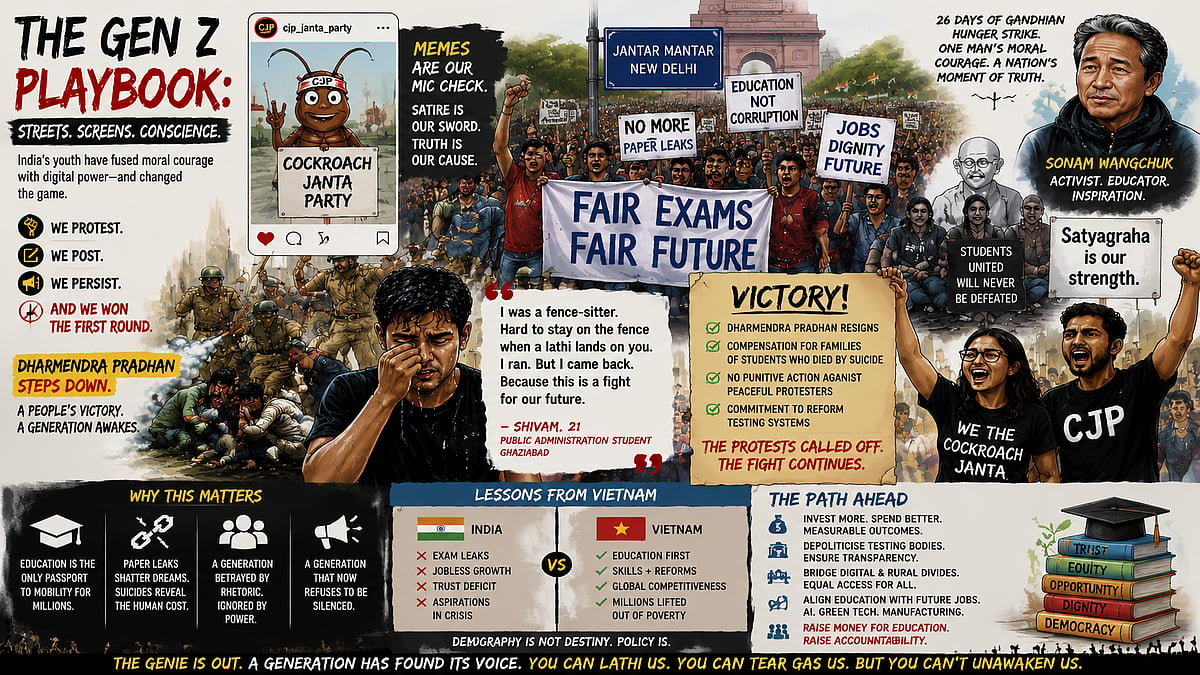
India's Gen Z has rewritten the protest playbook masterfully, fusing the moral with the digital. Taking to the street and the stage and using Instagram, memes, and digital satire, they pitched their demands to the Narendra Modi government. They have won the first round. Dharmendra Pradhan finally stepped down as education minister—a key demand of the youth protesters led by the Cockroach Janta Party (CJP) movement. The protesters wanted Pradhan out over the May NEET-UG (India’s hugely competitive national entrance exam for undergraduate medical courses) paper leak that affected more than two million students and triggered suicides.
Images of education and environment activist Sonam Wangchuk’s 26-day Gandhian hunger strike at Delhi’s Jantar Mantar—joined by six student activists and CJP founder Abhijeet Dipke—travelled the world, giving the youth protests a crucial moral sheen, massive visibility, and swelling crowds.
Visit biznow.biz for more information.
Following multiple meetings with two Union ministers, the CJP has called off its nationwide protests. It says the Modi government has agreed to its other principal demands as well, including compensation for families of students who died by suicide after being required to retake examinations and assurances of no punitive action against peaceful protesters.
The street protests at Delhi’s Jantar Mantar, and across scores of Indian cities, exposed stark youth discontent under the Modi government. At their core lies one issue: jobs, the promise of a fair chance for a generation told to aspire.
How this pans out eventually in a country with the world’s largest Gen Z population (370–400 million) remains to be seen. This generation, born roughly between 1997 and 2012, feels betrayed. Political rhetoric raised their aspirations sky-high; reality smashed them. That betrayal was starkly visible at Jantar Mantar, India’s most iconic address for democratic dissent. For most without wealth or connections, education is the only passport to mobility. When that system collapses—through repeated exam leaks or failures like CBSE’s on-screen marking fiasco—aspirations crash.
“I was a fence-sitter," Shivam, 21, clad in a black T-shirt, told me. A public administration student from Ghaziabad preparing for competitive exams, he came from a family of government employees who support the establishment. Curiosity brought him to Jantar Mantar on July 20. Then the tear gas hit. As he bent to rinse his eyes, a lathi struck his shoulder. "Hard to stay on the fence when a lathi lands on you," he said. "I ran."
Shivam has returned every day since. "I am here because this is a fight for our future. They pushed us to aspire, and now our dreams are being snatched."
I will not forget that exchange—or the many others from my visits to the Jantar Mantar site. The crowd defied easy labels: grandmothers who had sneaked out, young women and men, children, families, small-town and big-city residents, the affluent, and the poor. They came from near and far, braving obstacles because they had finally overcome fear of those in power, the street, and the unfamiliar.
In the scorching summer of 2026, accountability in education—long pushed to the margins of India’s political discourse—moved centre-stage. The immediate trigger was the NEET-UG 2026 paper leak scandal involving the National Testing Agency (NTA).
Between the cancellation of the exam and the June 21 retest, at least 20 NEET aspirants reportedly died by suicide. 2024 saw a similar leak. This time, a retest was ordered, and arrests were made.
The youth-led protests continued for days, with a tepid response from the Modi government. What really lit the fuse was a brutal assault on young, unarmed protesters. Police used lathi charge and tear gas against protesters at Jantar Mantar, including minors and women, as they attempted to march towards Parliament on July 20. Several protesters with serious injuries had to be hospitalised. One 19-year-old risks losing his vision. Police personnel have also been injured. On July 23, in a midnight address, Prime Minister Modi promised “more strict actions” against paper leaks and the complete overhaul of the NTA.
India’s education system is broken. Restoring trust will be a key challenge.
This crisis matters because education is central to India’s economic ambitions. With a massive demographic dividend, the country seeks developed-nation status by 2047. Yet, weak human capital, skill mismatches, and declining trust threaten to turn that dividend into a liability.
Vietnam offers a sharp regional lesson. Its elevation to upper-middle-income status in July 2026 came as India witnessed youth protests over education reform—a coincidence highlighting a shared Asian challenge: how to turn a young population’s aspirations into productive opportunities. Emerging from war and poverty, Vietnam transformed itself through decades of Doi Moi reforms. It treated education as a strategic priority: expanding access, improving teacher quality, strengthening foundational learning, and aligning curricula with economic needs. Vietnamese students have repeatedly performed strongly on international assessments. That sustained focus on education and workforce development has attracted foreign investment, raised productivity, and lifted millions out of poverty.
Demographic advantage is not automatic. Young populations become economic strengths only when education systems deliver skills, trust, and real pathways to opportunity. India’s 2026 student protests show a generation demanding that education finally receive the seriousness it deserves. Policymakers now have a clear opening: raise effective spending on education with measurable outcomes, depoliticise testing bodies, bridge urban-rural and digital divides, and align education with future jobs in AI, green technologies, and manufacturing. India needs more money for education and accountability.
The genie is out. A generation has found its voice.
Patralekha Chatterjee is a writer and columnist who spends her time in South and Southeast Asia, and looks at modern-day connects between the two adjacent regions. X: @Patralekha2011