Indian Airline Sector: Relief For Now, But Reforms Get Pushed Around
· Free Press Journal
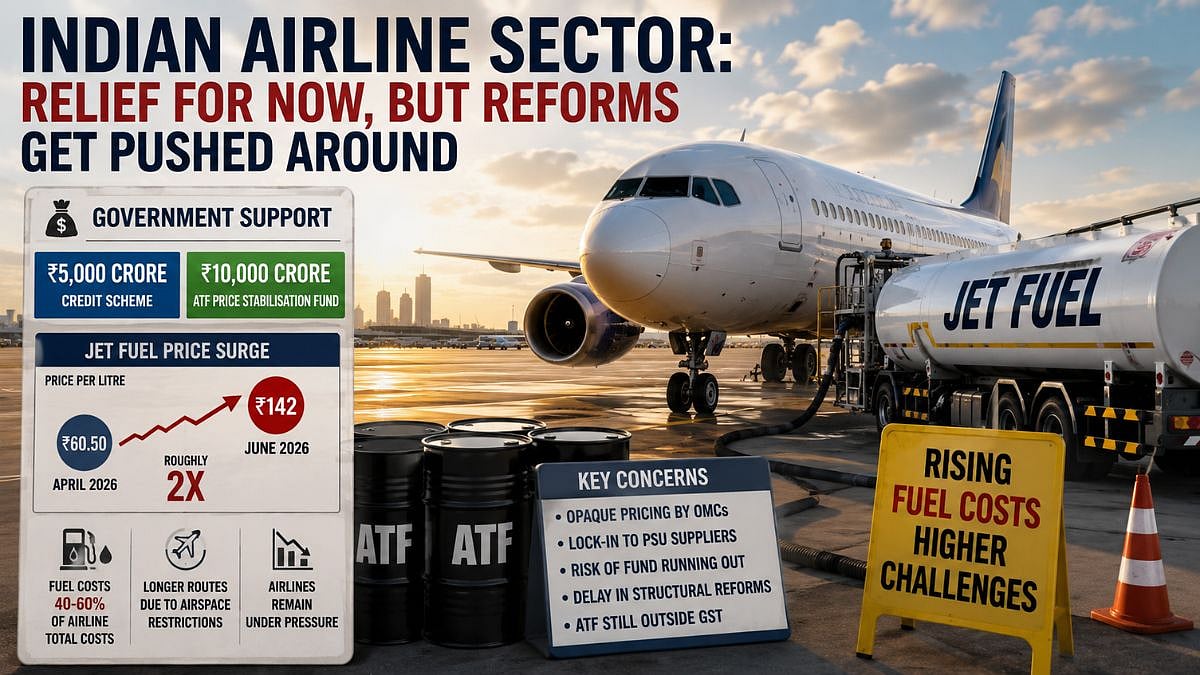
Last week, the government took another decisive step towards mitigating the impact of rising jet fuel prices on domestic airlines by rolling out a Rs 10,000 crore Price Stabilisation Fund for aviation turbine fuel. Earlier this month, the government had approved a Rs 5,000 crore credit scheme for the airline sector to neutralise the impact of the ongoing war in West Asia.
Rising fuel costs and operational pressures
Visit casino-promo.biz for more information.
Jet fuel prices have roughly doubled in two months—from Rs 60.50 to Rs 142 a litre—because of the West Asia crisis. Fuel, as is well known, accounts for 40–60 per cent of an airline's total costs, and with Pakistan shutting its airspace to Indian carriers, flights to Europe and the US now take longer routes and burn even more fuel.
The government’s Rs 10,000 crore pool of money must come as a relief for the airline sector, which is already running at a loss, with India’s biggest carrier, IndiGo, posting a loss of Rs 2,536 crore during the fourth quarter of FY26.
How the Price Stabilisation Fund works
The scheme works as follows: the government picks a "normal" fuel price (the benchmark). When the actual price climbs above that line, the government temporarily covers the difference so airlines aren't hit with the full spike. The money goes to the oil companies that sell the fuel as an interest-free loan.
The government expects to recover the money later—the scheme runs until the full amount is repaid. However, to be eligible, airlines must buy all their fuel only from government oil companies for up to three years. They receive immediate relief in exchange for giving up the freedom to shop around for fuel later.
Potential risks and structural issues
The bigger concern is that if prices remain high, the Rs 10,000 crore pool could deplete quickly, and the loan may effectively become a subsidy that is never repaid.
A larger issue remains unaddressed: airlines have repeatedly raised concerns about the opacity of pricing by oil marketing companies (OMCs) and have independently sourced fuel to mitigate costs. With the government mandating that airlines seeking benefits from the scheme buy ATF exclusively from Indian OMCs, it locks them into the very suppliers they have been complaining about.
Concessions from the government should ideally be unconditional. Imposing conditions provides only temporary relief and freezes competition, consolidating the PSU oligopoly. Experts argue that the government must address structural reforms, including unifying fuel taxation across states and including ATF under the GST, to provide long-term stability to the airline sector.