Brave New Wild: A Paler Shade Of The Past
· Free Press Journal
Cinema has long warned that when man plays God, the results usually involve being chased through a rainforest by a very disgruntled reptile whose territory has been encroached upon. The Jurassic Park franchise built a multi-billion-dollar empire on the premise that rewilding the prehistoric is a recipe for logistical disaster and an arrogant breach of health-and-safety protocols.
Yet, in the real world, a venture-backed start-up named Colossal Biosciences seems to have treated these films less as a cautionary tale and more as a series of instructional videos.
Visit freshyourfeel.com for more information.
De-extinction projects gather momentum
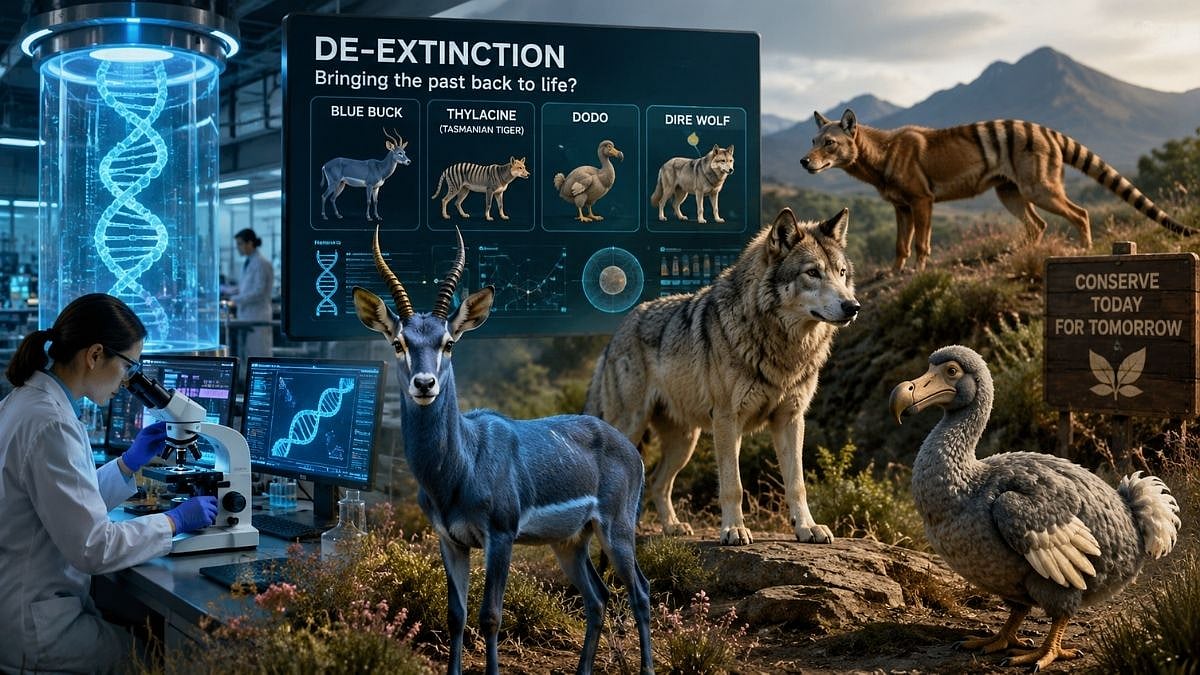
The latest guest list for this biological revival includes the blue buck, a velvet-hued antelope of South Africa that has been absent from the fynbos, which is Afrikaans for its shrubland habitat, since, say, 1800.
Unlike the velociraptor, the blue buck is unlikely to open doors or hunt in packs — more likely the reverse, given human tendencies. It was, by all accounts, a slightly more colourful version of its surviving cousins.
But the blue buck is only the tip of a very expensive iceberg. Colossal is juggling a portfolio of de-extinction projects that reads like a ledger of human ecological guilt.
The thylacine (Tasmanian tiger) is being engineered for a return to the Australian bush, while the dodo — that avatar of evolutionary avian clumsiness — is slated for a homecoming in Mauritius. Even the dire wolf, a beast familiar to fans of high-fantasy television, is on the drawing board.
Science behind species revival sparks debate
The science is as elegant as it is controversial. By utilising gene editing to splice ancient DNA into the genomes of modern proxies, researchers are creating functional versions of lost species in laboratories spanning from Texas to Melbourne.
A thylacine-like creature birthed by a fat-tailed dunnart is not strictly a thylacine; it is a high-tech approximation, a biological cover band playing the hits of the Ice Age. In other words, a mouse-like genetic precursor to the lost tiger.
The debate over these resurrections is far from settled. Critics argue that spending millions to revive a single bird while thousands of existing species teeter on the brink is a spectacular misallocation of capital.
There is also the question of where a revived dire wolf fits in a world that can barely tolerate the presence of a standard-issue coyote.
A future shaped by biological nostalgia
What the future holds is a strange symmetry. Man continues to create the conditions — you guessed it — climate change and habitat loss, that drive species to the wall and beyond. Yet, simultaneously, our prowess in genomic editing is making the permanently gone look increasingly temporary.
We are entering an era of biological nostalgia, where the wild is no longer a fixed state but a curated collection.
Yes, the wilderness may become a high-concept theme park, populated by creatures that owe their existence as much to Silicon Valley venture capital as to natural selection. It is a brave new world.