'Okay, Approved Bestie!' Manager’s Reply To Gen Z Employee's Bold Leave Request Email Goes Viral; Internet Divided
· Free Press Journal
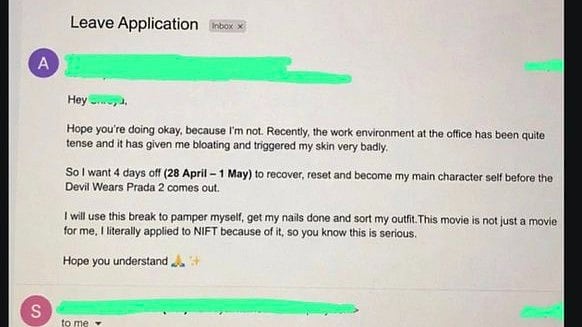
A Gen Z corporate employee has sparked massive online conversation after sending a refreshingly honest leave request, and receiving an equally unexpected response.
What began as a simple email quickly turned into a symbol of how workplace communication is evolving in 2026.
Visit asg-reflektory.pl for more information.
Screenshots circulating on social media show an employee abandoning traditional corporate language entirely. Instead of formal phrasing, the message opened with a candid confession: they were not feeling okay and needed a break from a stressful office environment that was affecting both their physical comfort and skin health.
Corporate world is not ready for GenZ girls pic.twitter.com/JIM8mLfFz1
— Prayag (@theprayagtiwari) April 24, 2026
The employee requested four days off, from April 28 to May 1, explaining the leave was meant for recovery, self-care, and personal reset.
But the request didn’t stop there.
The email framed the time off as a “main character” moment, a chance to recharge before the release of The Devil Wears Prada 2, a sequel to the cult-favorite fashion film that inspired their career ambitions. The employee even shared plans for the break, including self-care appointments, styling outfits, and mentally preparing for the movie’s release.
The manager’s reply that stole the show
Instead of a stern corporate response, the manager replied with just a few words that instantly went viral, “Okay, approved bestie.”
Leave approved to watch Devil Wears Prada 2 . They are fighting for menstrual leave and they are getting leave to watch series
— Himanshu Singh Rajput ⚔️ (@therajputchhora) April 24, 2026
The relaxed tone surprised many online users, who expected disciplinary action or at least a more formal reply. Instead, the exchange became an example of how workplace culture, especially among younger professionals, is shifting toward authenticity and empathy.
Social media reacts
The internet quickly divided into two camps.
Many users praised the interaction, calling it proof that modern workplaces are becoming more human-centric. Some commenters argued that flexibility, humour, and understanding managers help improve employee loyalty and retention, something companies increasingly prioritise as burnout and quiet quitting remain major workplace discussions.
This is stupid.
— ab.haiii (@ab_nhi_hai) April 25, 2026
My emails are generally like -
Hello,
I will be on leave on 28th April and 1st May.
Thanks
Others joked that fictional fashion boss Miranda Priestly would never approve such an email, while several users admitted they were simply jealous of both the leave approval and the supportive manager.
However, criticism also emerged. Some users felt the reason for leave appeared trivial compared to ongoing conversations around serious workplace benefits such as mental health leave, menstrual leave, and flexible work policies. Critics questioned whether blending internet humour with professional communication risks blurring workplace boundaries.